Monday, April 8, 2019

Week 12: April 8 - 12

Welcome to Week 12!

MONDAY:  After completing today's bell ringer assignment, the students and I discussed how to write an accurate written response as we discussed both "correct" and "incorrect" student responses.  Those who had created all correct responses to Friday's homework assignment then turned in their work to me.  All other students were assigned the task of correcting their mistakes and then turning in their assignments tomorrow after their corrections have been made.
Homework: Fix all of the mistakes from Friday's homework assignment, and study for tomorrow's vocabulary quiz.


TUESDAY:  After completing today's bell ringer (exception: 7th period due to Code Red drill), the students took a vocabulary quiz.  After completing the quiz, the students were instructed to read, annotate, and complete the practice problems for Lesson 16.

Homework: Finish reading, annotating, and completing the practice problems for Lesson 16.

WEDNESDAY:  After completing the bell ringer, we discussed the answers to the Logical Fallacies Quiz.  Next, the students were assigned the task of completing an addition to their Logical Fallacies Study guide on a separate sheet of paper, incorporating the 3 distracting techniques of Lesson 16 and using the same format as the study guide they have already completed.  See below for a visual example of how they were required to get started on this assignment.
Homework: Finish the assignment which was begun in class.


THURSDAY:  In today's class period, I led the students through a discussion of the 3 distracting techniques. The students learned the answers to the practice problems the should have completed for homework, and they watched 3 short video clips (see below) that further explained the distracting techniques. Finally, the students broke out into small groups to create one example of a distracting technique which they will present to the class tomorrow.
Homework:  Complete the group work if it was not completed during class.

Red Herring video

Ad Hominem video

Straw Man video

FRIDAY: After completing the bell ringer assignment for today, the students were given back their vocabulary quiz, and I announced the correct answers to the quiz.  Next, the students presented the distracting technique created by their group yesterday in class.  Finally, I gave the students a worksheet to help them develop an understanding of how all of the logical fallacies, including the distracting techniques, fit together.  They were asked to complete the Logical Fallacies Summary worksheet by doing the following things:
1. List all 11 fallacies we have covered in class.
2. Write the type of reasoning on the left side margin (see below) that correlates to the logical fallacy next to it.
3. Create a "helpful hint" next to each fallacy that will help the student remember the meaning of each fallacy.
 If they did not finish this assignment during class, they were told to finish this assignment for homework.
Homework:  Complete the Logical Fallacies Summary worksheet given in class.


This week's BELL RINGER assignments:

MONDAY: Correct the grammar.
1. ms ashford our senator shaked our hands at the dinner meeting
2. the president of the perfect cat food company exclaimed thats the most large cat i have ever seen

TUESDAY:  Correct the grammar.
1. in this issue of planet, there is a article called learning to recycle
2. politeness a sense of humor and respect for other people ms smith stated can help you in any job

WEDNESDAY:  Correct the grammar.
1. i have began therefore to do these things find there addresses send out invitations and contact youre friends
2. because it snowed we did not taked the children to the Game

THURSDAY: Correct the grammar.
1. have you read midnight thunder mr toscas exciting short story
2. they went to the stewpot restaurant for breakfast and then they drived to the river

FRIDAY: Correct the grammar.
1. she has spoke several languages such as spanish italian and gaelic during her stay
2. although she was the smaller girl of the group she performed good


Monday, April 1, 2019

Week 11: April 1 - 5

Welcome to Week 11.

MONDAY: Today I collected last week's bell ringer assignment (Week 10 Bell Ringers).  Then, the students completed today's bell ringer assignment (see below).  We spent the remaining time in the class period reading, annotating, and completing the practice problems in Lesson 15: Errors in Inductive Reasoning.
Homework:  Finish reading, annotating, and completing all practice problems in Lesson 15.


TUESDAY:  Due to the FSA Writing Test that took place today, we experienced a shortened class period.  After completing the bell ringer for today, we discussed the logical fallacy of Post Hoc, Ergo Propter Hoc (False Cause) and the corresponding practice question in Lesson 15.

WEDNESDAY: Today I returned 3 graded assignments: the logical fallacies worksheet, the quiz, and last week's bell ringers assignment.  After completing today's bell ringer assignment (see below), the students viewed 4 short videos (click on the fallacies below to view the videos) on the logical fallacies presented in Lesson 15. Afterwards, they were given some time in class to add these 4 logical fallacies to the Logical Fallacies Study Guide that they started last week.

Chicken and Egg video

Hasty Generalization video

Composition video

Post Hoc, Ergo Propter Hoc video

Homework:  Add the remaining 4 logical fallacies to your study guide that you started last week (format shown below), and STUDY FOR THE QUIZ that you will take tomorrow covering all 8 logical fallacies.

5. (Name of the logical fallacy)
    a. Definition:

    b. Additional information:

    c. Example:

THURSDAY:  After completing the bell ringer assignment today, the students took a Logical Fallacies Quiz.  If they finished the quiz before the class period ended, they were instructed to complete their study guide.  I collected the Logical Fallacies Study Guide at the end of the class period.

FRIDAY: After completing today's bell ringer assignment, the students read the article, Battle Over the Border Wall, from Scholastic's Upfront Magazine.  This article is posted below.  After reading the article, the students answered the following 4 questions by applying everything they know about how to write an accurate written response.  As well, for each response they were required to write their answer using only the following number of sentences:

Question #1: Use 2 sentences for your response.
Question #2: Use 1 sentence for your response.
Question #3: Use 3 sentences for your response.
Question #4: Use 2 sentences for your response.

Homework:  Complete the 4 questions about the article.


Battle Over the Border Wall
What you need to know about the legal showdown over the president’s national emergency declaration
On February 15, President Trump declared a national emergency to fund the construction of a 1,000-mile wall on the border with Mexico after Congress provided money for only a sliver of the project.
The announcement came as the president signed a spending deal negotiated by Democrats and Republicans in Congress that included $1.375 billion for border fencing, but not the $5.7 billion Trump had been demanding for construction of a much longer wall. The agreement headed off what would have been the second shutdown of the federal government in the space of a month over the issue. But Trump’s declaration prompted lawsuits that set up a constitutional showdown over the separation of powers and the president’s authority.
Here’s what you need to know to understand the battle over the emergency declaration.

Classroom magazines image
Evan Vucci/AP Images
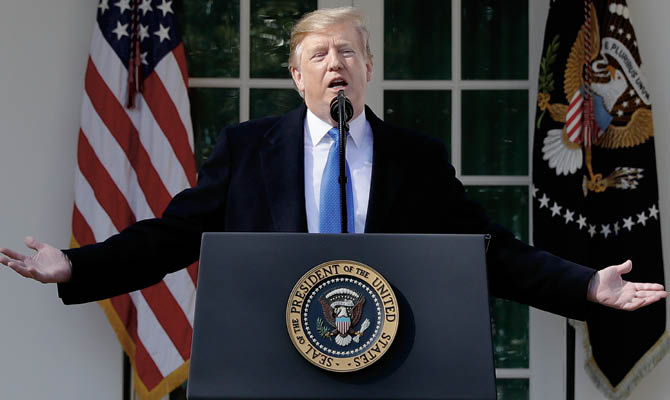
President Trump announces the emergency at the White House.
What’s the conflict about?
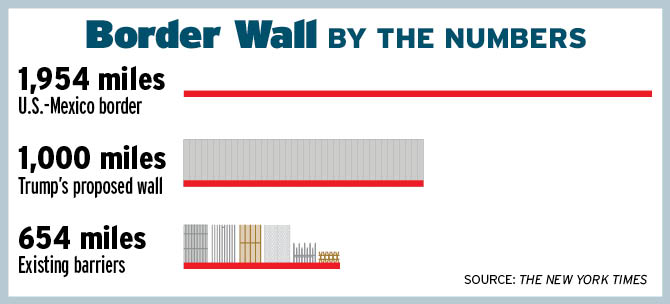
Since December, Trump has been asking for $5.7 billion to build a wall along the southern border. About 650 miles of the 2,000-mile-long border between the U.S. and Mexico already have some kind of barrier (see graphic below). Building a wall along the entire border was a key campaign promise—something Trump said would stop the flow of undocumented immigrants and illegal drugs into the U.S.
Trump’s insistence on billions for the wall after Congress refused to allocate it led to a government shutdown that began in late December and lasted a record 35 days, forcing some 800,000 federal employees to go without their paychecks.
In response to Trump’s emergency declaration, 16 states, including California and New York, filed a lawsuit arguing that the president doesn’t have the authority to divert funds for constructing a wall along the Mexican border because Congress controls federal spending.


Loaded: 5.93%
Remaining Time 2:48
The Border Wall
The 2,000-mile-long border between the U.S. and Mexico, now so contentious, wasn’t even well marked in earlier days.
What’s a national emergency?
Congress has enacted laws that permit the president, upon declaring a national emergency, to take steps that would normally be forbidden by law. The idea is to allow the executive branch to move quickly in emergency circumstances.
The National Emergencies Act of 1976 gives the president broad authority to decide whether an emergency exists. Presidents have used this law to declare emergencies about five dozen times. But most of those cases dealt with foreign crises and involved freezing assets or blocking trade or exports, not redirecting money without congressional authorization.
White House officials cite two times that such emergency declarations were used by presidents to spend money without legislative approval—once by President George H.W. Bush during the run-up to the Persian Gulf War (1990-91), and then by President George W. Bush in 2001 after the 9/11 terrorist attacks.
Legal experts have pointed to several statutes that permit the executive branch to redirect military construction funds in an emergency. One such law, for example, permits the secretary of defense to begin military construction projects “not otherwise authorized by law” that support the armed forces.
No wall can be built until the lawsuits are resolved.
Is there really an emergency at the border?
That’s the crux of President Trump’s argument. “We’re talking about an invasion of our country,” Trump said when he announced the emergency declaration, “with drugs, with human traffickers, with all types of criminals and gangs.”
Critics argue that the facts don’t support that. The number of people crossing the border illegally is far lower than it was in the late 1990s and early 2000s, according to official government statistics. The relatively new and growing phenomenon of caravans of Central American migrants consists largely of families who present themselves to border officials and request asylum, rather than trying to elude authorities. Thousands of these Central American families have been apprehended in recent months. Critics say a wall would have little effect on the flow of illegal drugs into the country, which  U.S. Customs and Border Protection says are mostly smuggled through official ports of entry.
President Trump may also have undercut his own argument for declaring an emergency when he told reporters at the White House, “I didn’t need to do this, but I’d rather do it much faster. I just want to get it done faster, that’s all.”
“Probably the best evidence [for overturning the declaration] is the president’s own words,” says California Attorney General Xavier Becerra.  
Why is this showdown a big deal?
While President Trump argues he’s well within his rights to declare an emergency, constitutional scholars and many lawmakers are alarmed that his decision sets a dangerous new precedent. The Founders deliberately gave Congress, not the president, the authority to make laws and to allocate money—the so-called “power of the purse.” What will prevent future presidents, they argue, from declaring emergencies if they can’t get Congress to approve whatever project they want?
“It sets a precedent that a president can, without regard to an actual existence of an emergency, use this tool to evade the normal democratic process and fund projects on his own,” says William Banks, a Syracuse University law professor.
What happens now?
The lawsuits filed against President Trump—and the likelihood that others will soon follow—means that with court actions pending a wall won’t go up anytime soon.
It’s not clear how the legal questions will be resolved. The courts are often reluctant to substitute their own judgment for the president’s when it comes to security matters. In other words, the courts may not even address the question of whether the facts warrant an emergency declaration, preferring instead to defer to the president on a national security issue. The courts could end up focusing on whether states can show they’re being harmed by the president’s diversion of funds to build the wall.
In addition to the uncertainty about how the courts will rule is the possibility that Congress could get fed up with presidents using emergency powers and vote to restrict them.
“The risk the president runs is that Congress will take away much, if not most, of the discretion it’s given to the president,” says Stephen Vladeck, a law professor at the University of Texas, Austin. “And then the concern is that Congress could hamstring a future president from having all the tools he or she might need to react to a future emergency. So a short-term win for the president could become a long-term loss for the presidency.”
With reporting by Charlie Savage and Robert Pear of The Times.

THIS WEEK'S BELL RINGER ASSIGNMENTS:

Monday:  Correct the grammar.
1. after looking in every room, they still couldnt find me and tomas
2. which one of you are going to do the shopping for grandma

Tuesday: Correct the grammar.
1. after i write this letter im going to do the dishes take a walk and read a book
2. there going away for a Week and then theyll visit chuck and i

Wednesday:  Correct the grammar.
dear sir or madam
please send replacement part #685 as soon as possible a check is enclosed
sincerely
yukio i ishigure

Thursday:  Correct the grammar.
1. father said that its to cold to lay by the pool this morning
2. the boys they could of visited us if we had known they were in the neighborhood

Friday:  Correct the grammar.
1. this spring said julio were taking a trip to visit the east
2. while waiting for the Movie to begin, rebecca remarked im thirsty

Monday, March 25, 2019

Week 10: March 25 - 29

CONGRATULATIONS!  You have made it to the FINAL QUARTER OF 6TH GRADE! 

MONDAY:  Today, we began our study of "logical fallacies."  We added this term to our vocabulary list (#20) and defined the term as follows:

Logical fallacy: logical error; error in reasoning

We then jumped into Lesson 13: Errors in Deductive Reasoning.  The students and I began reading and discussing this lesson which introduces 4 common logical fallacies of deductive reasoning:

1. Slippery Slope
2. False Dilemma
3. Circular Reasoning
4. Equivocation

Homework: Finish reading and annotating Lesson 13, and complete all practice problems within this lesson.


TUESDAY:  Today we discussed the answers to the practice problems and discussed briefly the last 2 logical fallacies in the lesson: circular reasoning and equivocation.  To further solidify the students' understanding of these fallacies, I showed the following short video clips:

Slippery Slope video

False Dilemma video

Circular Reasoning video

Equivocation video

To wrap up our study of these 4 logical fallacies, the students began to create a "Logical Fallacies Study Guide" to prepare them for the final exam.  I have listed the structure for this study guide below. I also told the students that for their "examples" they must create their own unique examples and NOT copy examples from the lesson.

Logical Fallacies Study Guide

1. Slippery Slope
    a.  Definition:
    b.  Additional Information:
    c. Example:

2. False Dilemma
    a.  Definition:
    b.  Additional Information:
    c. Example:

3. Circular Reasoning
    a.  Definition:
    b.  Additional Information:
    c. Example:

4. Equivocation
    a.  Definition:
    b.  Additional Information:
    c. Example:


Homework:  Complete the Logical Fallacies Study Guide for all 4 logical fallacies covered in Lesson 13.

WEDNESDAY:  After working with the students through today's bell ringer assignment, I introduced the next lesson, Lesson 14: Inductive Reasoning. To introduce this topic, I explained the following information to the students (see below), and after my explanation, the students copied down this information in their notes.


After copying down this information, the students were directed to read and annotate Lesson 14 and complete all practice problems within this lesson.


HOMEWORK:  Finish reading, annotating and completing the practice problems in Lesson 14.

THURSDAY:  To further explain the difference between deductive and inductive reasoning, I showed the students a short video about Raul and Isaac, two young boys who learn differently.   I also went over the highlights of Lesson 14, and then I distributed my own outline of Lesson 14 (see below).  Afterwards, the students took a short quiz to test their knowledge.  After the quiz, I passed out a worksheet to be completed using the information given from either the notes taken in class (see above) or Lesson 14.


Homework:  Complete the following worksheet using only the information from Lesson 14 and the notes you took in class on Wednesday.


FRIDAY:  After completing the bell ringer assignment, the students were instructed to read the article entitled, "Second Chances" (see below). Then, they worked to complete the 3-page handout (see below) given to the them by my substitute teacher.  
Homework:  Complete the 3-page handout.


BELL RINGERS for Week 10:

Monday: Correct the grammar.
1. the keane twins are more tall than i and my sister
2. after we had shaked hands i discovered that he could speak spanish good

Tuesday:  Correct the grammar.
1. youre dog likes to lay in the shade on hot days
2. lauren cried the water is too hot

Wednesday:  Correct the grammar.
1. the fall of rome john fletchers latest book is really exciting
2. no i must bring this book back to the library before Saturday

Thursday:  Correct the grammar.
1. the french was told to lie down there weapons and surrender
2. dad they want to talk to i and omar soon

Friday:  Correct the grammar.
1. we drived for ten hours but i wouldnt want to do that again
2. tom can drive a car but he would rather walk or take an bus

Monday, March 18, 2019

March 18 - 21

Welcome back from Spring Break!  This is a 4-day work week.

MONDAY:  This week we begin our study of Deductive Reasoning.  After completing today's bell ringer assignment, we jumped right in to Lesson 12: Deductive Reasoning.  The students and I talked about why it is important to learn how to make deductive arguments as well as the necessary requirements of a deductive argument.  We discussed the information on pages 91 and 92 as well as part of page 93.
Homework:  Read, annotate and complete the practice problems on pages 93 -94.


TUESDAY: After a review of last night's homework assignment, I guided the students through the first part of their Lesson 12 outline.  Shown below is the amount of information that we covered in today's class.


Tonight's homework: 
1. Finish part I.B. of the Lesson 12 outline.

2. Read and annotate pages 95 & 96 of Lesson 12 and complete the practice questions.


WEDNESDAY:  Mrs. Wilkins was my substitute today. After discussing the qualities of a deductive argument (I.B.), she collected the first part of the students' outline.  Next, she went over the remaining two pages of Lesson 12 and guided the students to complete the second part of this outline on a separate sheet of paper and provided the students with a framework for this outline (see below). Finally, she passed out a worksheet to all of the students to begin creating examples of syllogisms, conditionals, and invalid deductive arguments.  

II.
     A.

         1. 
         2.
     B.
         1.
         2.
III.
      A.
      B.

Homework: Complete the 2nd part of the Lesson 12 outline (above) and complete the "Syllogisms, Conditionals, and Invalid Deductive Arguments" worksheet.


THURSDAY:  As I was still recovering from an illness, I had another substitute teacher cover my class today.  She discussed the second part of the Lesson 12 outline.  Next, she allowed the students to work in groups to discuss their answers to the worksheet.  Finally, the student groups were allowed to present their "best answers" to the class.

FRIDAY: NO SCHOOL (Teacher Planning Day)

This week's Bell Ringer assignments:

Monday:  Correct the grammar.
1. the south has it's own unique culture and traditions
2. i, to, have just finished reading there isnt time eleanor farjeons poem

Tuesday:  Correct the grammar.
1. mr millier the principal had spoke at the school assembly on wednesday
2. paul revere's ride is a long poem that many people have readed

Wednesday:  Correct the grammar.
1. please bring these here books and put them in youre bag
2. them boys are practicing deck the halls for the christmas concert

Thursday:  Correct the grammar.
1. yes mom will take we boys to the fair on saturday
2. will you right as soon as you move into your new Home asked miguel